
- STMC-standardised page yield
- Stable print density and uniform solid fills across the full lifecycle
- Reliable fusing, no toner offset or flaking
- Sharp text, clean background, consistent grayscale reproduction
- Low leakage, minimal noise and no premature failure
- Batch-to-batch consistency
- Controlled particle size distribution
- Fusing performance tuned to match OEM fuser temperature and pressure
- Stable electrostatic charging
- Consistent performance across temperature and humidity variations
- Repeatable formulation for mass production
- Do you run internal toner formulation and application labs?
- How do you validate performance across different printer families?
- Are environmental stability tests standardised?
- What controls guarantee identical performance across batches?
- Chip design capability and SLA for post-firmware-update revisions
- Patent clearance processes to mitigate import IP risks
- Valid certifications: ISO 9001, ISO 14001, ISO 45001, STMC test reports
- Supporting documentation for CE, RoHS, REACH and WEEE for EU shipments
- What is your standard production lead time?
- How do you secure toner powder and chip supply?
- Can you lock specifications for repeat orders?
- How are urgent orders or seasonal demand spikes handled?
How to Choose a Reliable Toner Cartridge Manufacturer in China
China hosts the world’s dominant printing consumables cluster, with Zhuhai as the core hub for compatible toner cartridge manufacturers. While factory options are abundant, selecting a trustworthy manufacturing partner requires more than price checks or catalog reviews.
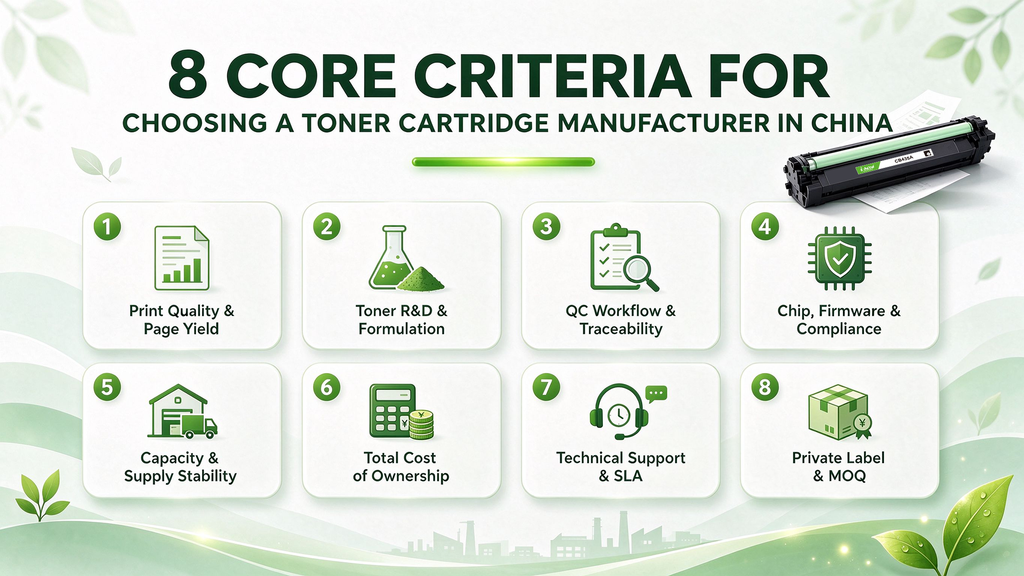
For distributors, private-label brand owners, wholesalers and Managed Print Services (MPS) providers, a qualified manufacturer must deliver consistent print performance, independent toner R&D, robust quality control, stable supply and sustained technical support. Below are 8 core evaluation criteria for vendor vetting.
1. Assess Print Quality Beyond Advertised Page Yield
Page yield is a baseline metric, yet it cannot reflect real-world reliability. A cartridge may hit rated yield while suffering uneven output or printer-side failures. Focus on these testable indicators:
Buyer Tips: Request samples and run tests on your target printer models. Compare outputs under identical STMC testing protocols and ask for formal test records.
2. Verify Toner Formulation and In-House R&D
Toner chemistry directly determines print stability. Many suppliers only fill purchased bulk powder; top manufacturers develop formulas in-house. Key technical checks:
Questions to ask:

3. Audit Manufacturing Workflow and QC Traceability
A mature quality system covers the full production cycle: incoming material inspection, first-article checks, in-process sampling, finished-product validation and closed-loop defect management. Look for clear batch traceability and formal AQL standards.
Automation improves consistency but does not replace inspection. Prioritise documented test procedures, dedicated lab equipment and corrective action workflows, rather than only factory scale or automated lines.
4. Check Chip, Firmware Resilience and Global Compliance
Chip and firmware compatibility is the top pain point for aftermarket consumables. OEM firmware updates frequently block third-party chips. Critical compliance and technical checks:
5. Evaluate Production Capacity and Supply Chain Stability
A reliable supplier must support both current orders and scaling demand. Raw material shortages, chip lead-time volatility and inconsistent delivery disrupt MPS service schedules and inventory planning.
Vet: actual output capacity, dual-source strategies for key components, inventory planning, lead-time reliability, peak-season arrangements and contingency plans for supply disruptions.
Questions to ask:
6. Calculate Total Cost of Ownership (TCO), Not Just Unit Price
The lowest quotation rarely equals the lowest running cost. For MPS teams operating on cost-per-page (CPP) contracts, unstable cartridge performance directly erodes margins.
TCO factors to include: real usable page yield, defect & replacement rate, service call frequency, printer downtime, troubleshooting labour and logistics costs. Always compare cost per usable page instead of unit price alone.
7. Review Technical Support and New-Model SLA
This is not a one-off purchase. Evaluate responsiveness to quality feedback, application troubleshooting, specification documentation and flexible order terms. A competitive partner maintains a fast new-model release SLA, critical for brand owners and MPS providers that need to launch support soon after OEM printers hit the market. Confirm warranty terms and clear claim procedures.
8. Confirm Private Label, Trial Order and MOQ Terms
For resellers building their own brands, verify custom packaging support, neutral stock options, trial-order allowances and flexible MOQ structures. This separates pure traders from genuine manufacturers that support customised B2B programmes.
Supplier Reference: iAICON (Zhuhai Aicon Image Co., Ltd.)
Founded in 2006, in Zhuhai’s printing consumables hub, iAICON is a B2B manufacturer aligned with the above criteria. It maintains in-house toner formulation labs, STMC-aligned testing and ISO management systems, tracks OEM firmware changes and supports private-label customisation. The company serves over 500 distributors and MPS partners across 127 countries. If you are running supplier validation against this checklist, share your target printer model list and testing requirements with iAICON for formal sample evaluation.
Frequently Asked Questions (FAQ)
Q1: How do I select a reliable Chinese toner cartridge manufacturer?
A: Evaluate print quality, toner R&D, QC traceability, chip/firmware resilience, compliance, supply stability, TCO and technical support. Request samples, STMC reports and compliance documentation before committing.
Q2: What certifications should a toner cartridge supplier hold?
A: Core standards include ISO 9001, ISO 14001, ISO 45001, plus STMC test reports for yield validation. Import markets may also require CE, RoHS, REACH and WEEE files.
Q3: What is STMC?
A: STMC (Standardized Test Methods Committee) defines uniform testing protocols for page yield and print quality. It is the globally recognised benchmark for compatible toner cartridges, widely adopted by MPS buyers and large distributors.
Q4: What is the difference between compatible, remanufactured and OEM toner?
A: OEM cartridges are original brand products; compatible cartridges are newly built aftermarket units; remanufactured cartridges use recycled empty shells rebuilt with new consumable parts. Each carries different pricing, risk and warranty profiles.
Looking for a reliable toner cartridge manufacturer in China?
Contact IAICON to discuss your product requirements, sampling plan and cooperation needs.
Website: https://www.iaicon.com/